Urban Air Mobility is often imagined as a citywide flying-taxi network: open an app, walk to a nearby vertiport, fly across the city, and land close to the destination. That vision is attractive, but it may not be the best place for UAM to begin.
Coppola, De Fabiis, and Silvestri ask a sharper question: should early UAM services focus on airport shuttles or city-taxis?
Using a large survey campaign in the Milan metropolitan area, the authors estimate how much travelers are willing to pay for travel time savings across different UAM use cases. Their conclusion is practical: airport shuttle services look more financially sustainable than city-taxi services in the early market.
Why the Question Matters
UAM has a deployment problem. A citywide air-taxi network requires many vertiports, high service frequency, public acceptance, reliable operations, and fares low enough to compete with taxis, private cars, public transport, and ride-hailing.
Airport shuttles are narrower. They connect airports with central business districts or major urban hubs. That means fewer routes, clearer demand, more time-sensitive travelers, and fewer infrastructure locations.
The question is not which vision is more exciting. The question is which one people are more willing to pay for.
The Milan Survey
The study uses a large stated-preference and revealed-preference survey in Milan. Travelers were interviewed at airports, rail stations, and other major urban hubs. The survey asked respondents about current travel behavior and then presented hypothetical choice situations involving cars, taxis, public transport, and UAM.
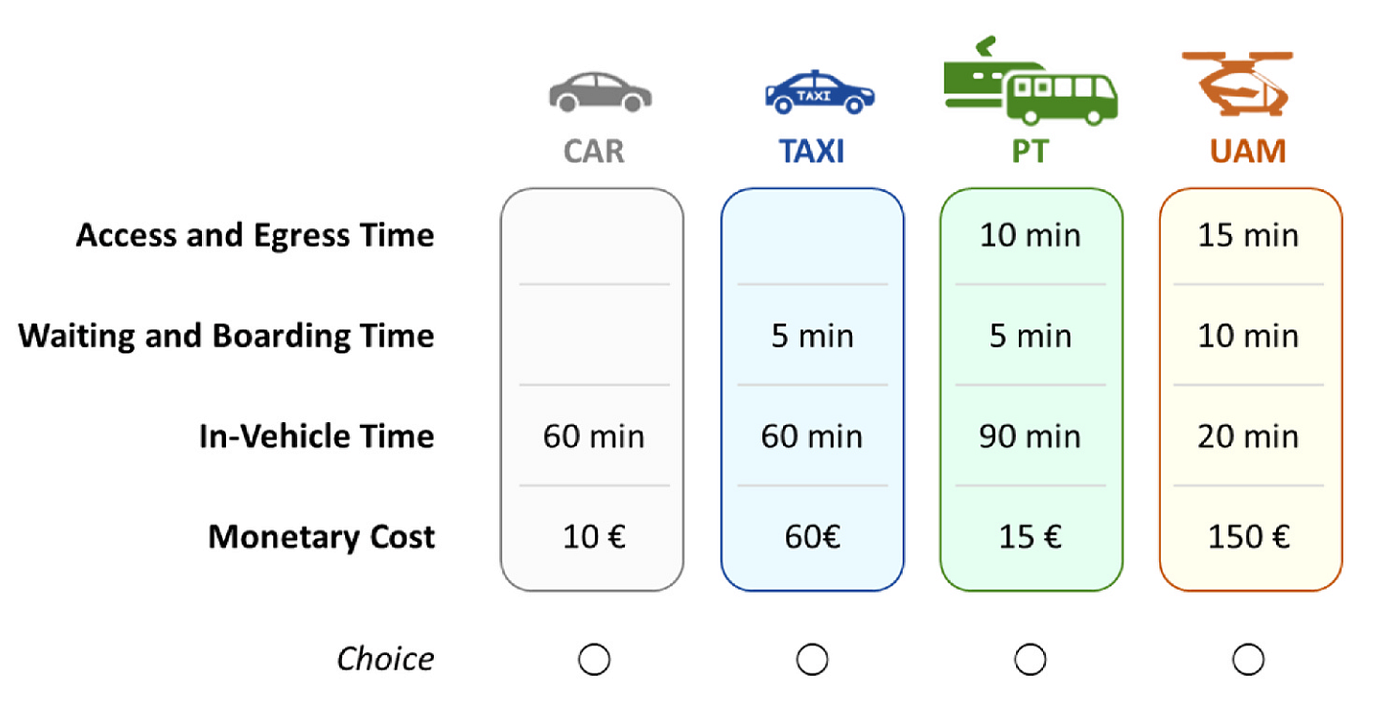
The authors use mixed logit models to estimate value of travel time savings. This metric tells us how much money travelers are willing to pay to save one hour of travel time.
That value is essential for UAM because the service will almost certainly cost more than many ground alternatives at first. If travelers do not value the time savings enough, the market will be thin.
Airport Shuttles vs. City-Taxis
The study compares two UAM use cases.
Airport shuttles connect airports with city centers or major business districts. These trips are often long, time-sensitive, and stressful when traffic is unreliable.
City-taxis serve trips inside the metropolitan area. These may be shorter and more frequent, but they face strong competition from taxis, metro lines, buses, trams, walking, cycling, and private vehicles.
The difference matters because UAM does not only compete on speed in the air. It competes on the full trip: access to vertiport, waiting time, boarding, flight, egress, fare, reliability, and perceived safety.
What Travelers Value
The study finds that willingness to pay for UAM airport shuttles is higher than for UAM city-taxis.
For airport shuttle services, estimated value of travel time savings ranges from about 48 to 69 euros per hour. For city-taxi services, the range is about 34 to 44 euros per hour. That means willingness to pay for airport UAM is roughly 44% to 57% higher than for metropolitan UAM trips.
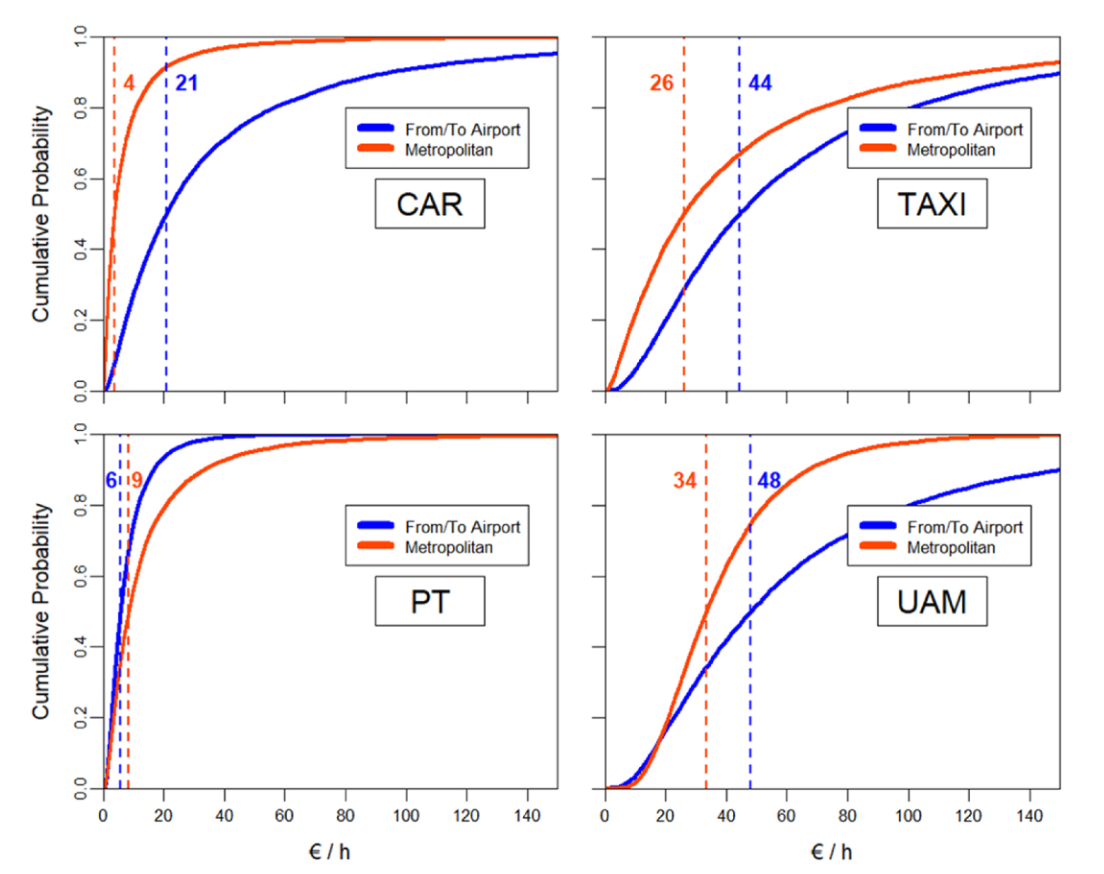
Business travelers are also more willing to pay than non-business travelers. The paper reports willingness to pay that is about 31% to 44% higher for business trips than for other purposes.
That makes intuitive sense. A delayed airport trip can mean a missed flight. A delayed business trip can mean a missed meeting. Time savings are more valuable when the consequences of delay are high.
Why Airport Shuttles Look Stronger
Airport shuttle UAM has three practical advantages.
First, the customer segment is clearer. Airport travelers, especially business travelers, already pay for time and reliability.
Second, the infrastructure network can start smaller. A shuttle system can connect a few airports and central hubs. A city-taxi network needs many vertiports before it becomes convenient.
Third, the trip purpose is stronger. Airport access is often stressful, expensive, and time-sensitive. Travelers may be more willing to try a premium mode if it helps them avoid road congestion and reduce schedule risk.
City-taxis do not have the same advantage. For many short urban trips, public transport or taxis may be good enough. If getting to and from vertiports takes too long, the air segment may not save enough total time.
Perception Matters
The study also shows that UAM adoption is not only a technical or economic question. Perception matters.
Travelers may respond differently based on income, trip purpose, age, gender, and comfort with low-altitude flight over dense urban areas. Safety perception, noise, unfamiliarity, and trust in the operator may shape demand as much as travel time.
This is one reason city-taxi services may be harder. Flying low over a dense metropolitan area may raise more concerns than taking a targeted airport shuttle route.
What This Means for UAM Operators
For early UAM operators, the lesson is not to promise everything at once.
A staged strategy may be more realistic:
- Start with airport shuttle corridors where willingness to pay is highest.
- Serve business-heavy and time-sensitive markets first.
- Build reliability and public trust through repeatable routes.
- Expand vertiport networks only where demand supports them.
- Consider city-taxi services later, when costs fall and infrastructure improves.
This is a more disciplined path than launching broad citywide service before the economics are ready.
Limitations
The study is based on stated-preference data. Respondents choose among hypothetical options, and real behavior may differ when actual prices, safety perceptions, weather delays, booking friction, baggage, and reliability are experienced.
The results are also specific to Milan. Cities with weaker public transport, worse airport access, different income distributions, or different airport geography may produce different results.
Still, the findings are valuable because they quantify something that UAM discussions often assume: willingness to pay is higher for airport access than for general city trips.
Final Thoughts
The Milan evidence suggests that UAM’s best first market may not be flying taxis everywhere. It may be airport shuttles.
That does not make city-taxis impossible. It means they are likely a later-stage market that needs denser infrastructure, lower fares, and stronger public acceptance.
Airport shuttles offer a clearer starting point: concentrated demand, higher value of time, fewer required vertiports, and a passenger group more willing to pay for reliability. For early UAM deployment, that may be exactly the kind of focused market the industry needs.
References
- Coppola, P., De Fabiis, F. and Silvestri, F., 2024. Urban Air Mobility (UAM): Airport shuttles or city-taxis? Transport Policy, 150, pp. 24-34. https://doi.org/10.1016/j.tranpol.2024.03.003
- ScienceDirect full text. https://www.sciencedirect.com/science/article/pii/S0967070X24000696