Urban Air Mobility is often discussed as if the aircraft are the hard part. But a working UAM market depends on a different question: who will actually choose it over existing modes?
Coppola, De Fabiis, and Silvestri study that question in Milan and the wider Lombardy Region. Their paper forecasts demand for three UAM use cases: airport shuttles, intercity air connections, and short-distance urban air taxis.
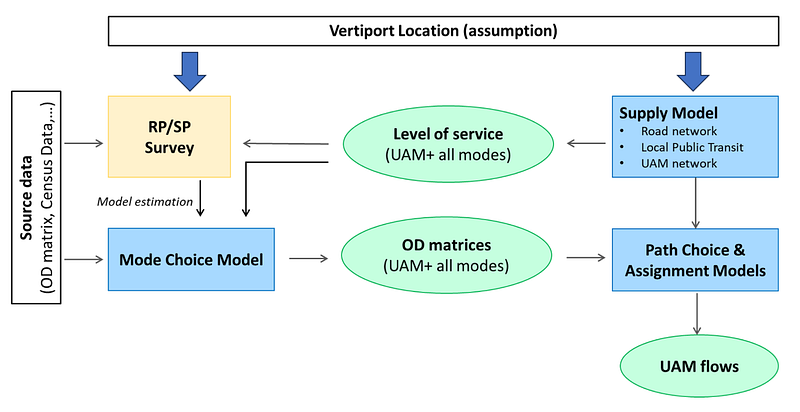
The study is useful because it does not assume that UAM will automatically attract passengers. It uses surveys, stated-preference experiments, random utility mode choice models, and multimodal network simulation to estimate when travelers may choose UAM and when they will stay with cars, taxis, trains, or public transport.
Why Milan Is a Useful Case Study
Milan is a strong test bed for UAM demand modeling because the region has several relevant travel markets at once.
It has airport-access demand through Linate and Malpensa. It has dense urban mobility inside Milan. It has intercity travel across Lombardy. It also has strong public transport and rail connections, which means UAM has to compete against real alternatives rather than an empty market.
That competition is important. If trains, metro lines, buses, taxis, and highways already provide good service, UAM must offer a meaningful advantage in time, reliability, or convenience.
The Three UAM Markets
The study evaluates three UAM services.
Airport shuttles connect airports with city or regional access points. This market is attractive because airport trips are time-sensitive, often business-heavy, and concentrated around major nodes.
Intercity air connections serve short regional trips across Lombardy. These routes may be useful where ground travel is slow, but demand depends heavily on distance, access time, and competing rail or highway options.
Air taxis serve short trips inside the metropolitan area. This is the most visible UAM concept, but also the hardest to justify where public transport and taxis already provide dense coverage.
Survey and Choice Modeling
The authors use a mixed revealed-preference and stated-preference survey. More than 2,100 travelers were interviewed across the Milan metropolitan area and Lombardy, including airports, railway stations, bus terminals, and major urban locations.
The revealed-preference part captures current travel behavior and traveler characteristics: trip purpose, mode, time, cost, income, age, vehicle availability, and other factors.
The stated-preference part asks respondents to choose among hypothetical alternatives such as car, taxi, public transport, and UAM under different travel times, access times, waiting times, and fares.
This is necessary because UAM does not yet exist as a mature service. Stated-preference experiments let researchers test how travelers may respond to new options before those options are deployed.
The Transport Model
The study embeds the estimated preferences into a multimodal transport model for the region.
The network includes roads, public transport, and simulated UAM services. The public transport network includes rail, metro, tram, bus, and trolleybus services. The road network is based on OpenStreetMap. The study area is divided into 613 traffic analysis zones, including detailed zoning inside Milan and separate zones for Linate and Malpensa airports.
UAM scenarios vary by the number of vertiports and by fare level. The paper considers scenarios with increasing UAM access points and decreasing fares, allowing the authors to test how infrastructure density and price shape demand.
What the Results Show
The study finds that airport shuttles are the most promising early UAM service. In the modeled scenarios, airport shuttles reach a modal share of about 2-5% for airport trips.
Air taxis are less dominant but still show some potential, with modeled modal shares around 1-3%. Intercity UAM demand is more sensitive to distance and access-egress time. Longer access time to or from vertiports quickly reduces attractiveness.
This is an important result. UAM is not a universal replacement for urban transport. It performs best where the trip is time-sensitive, the access points are convenient, and competing modes are less direct or less reliable.
Why Airport Shuttles Perform Better
Airport shuttles have several advantages.
Airport trips already have a clear start or end point. Travelers are often carrying time pressure because missing a flight is costly. Business travelers and high-income travelers are more likely to pay for time savings. Airport access also needs fewer vertiports than a dense citywide air-taxi network.
That makes airport shuttle service a more realistic launch market than broad urban air taxi operations.
Air taxis face a harder problem. Inside Milan, the metro, taxis, private cars, and public transport already serve many short trips. If access or egress to vertiports takes too long, the air segment cannot compensate.
The Role of Value of Travel Time
The study estimates value of travel time for different traveler groups and use cases. Airport travelers show higher values of time than many urban travelers, which helps explain why airport shuttles perform better.
Business travelers are especially important. They tend to value time savings more and may be less sensitive to price when the trip is work-related. Leisure travelers are generally more price-sensitive.
This does not mean UAM is only for wealthy travelers, but it does suggest that early demand may be concentrated in premium, time-sensitive segments.
Infrastructure and Fare Sensitivity
Two variables strongly shape demand: vertiport availability and fare.
More vertiports reduce access and egress time, which improves UAM attractiveness. But vertiports are expensive and difficult to place. A dense network improves demand but increases infrastructure cost and planning complexity.
Lower fares also improve demand, but fare reductions depend on aircraft utilization, operating cost, automation, energy cost, infrastructure cost, and business model design. If fares remain too high, UAM will stay limited to niche markets.
The Milan study makes this tradeoff visible. Demand grows when UAM becomes cheaper and easier to access, but both improvements require real deployment effort.
Why This Matters for UAM Planning
The Milan case study supports a pragmatic view of UAM.
Airport shuttles may be the best early market because they connect concentrated demand, high value of time, and fewer required access points. Intercity routes may work in selected corridors. Urban air taxis may need denser infrastructure and lower fares before they become broadly attractive.
For planners, this suggests a staged deployment strategy:
- Start with airport-access corridors.
- Test high-value intercity links where rail or road is weak.
- Expand vertiport coverage only where observed demand supports it.
- Treat citywide air taxis as a later-stage service, not the default first market.
Limitations
The study relies on stated-preference experiments because real UAM service is not yet available. Respondents may answer differently in a survey than they would when facing real prices, safety perceptions, weather delays, baggage needs, and service reliability.
The model also depends on assumptions about fares, eVTOL speed, vertiport locations, access time, waiting time, and future service quality. Real implementation will require updated data from pilots and early operations.
Even with those limits, the paper is valuable because it grounds UAM demand in traveler choice behavior rather than hype.
Final Thoughts
The Milan case study delivers a useful reality check. UAM may have a future, but its first successful markets are likely to be narrow and high-value rather than universal.
Airport shuttles stand out because the use case is clear: time-sensitive passengers moving between airports and the city. Air taxis are more challenging because short urban trips already have strong ground alternatives.
The main lesson is simple: UAM demand depends on the full trip, not only the flight. Vertiport access, fare, waiting time, competing modes, and traveler value of time decide whether people will choose the sky.
References
- Coppola, P., De Fabiis, F. and Silvestri, F., 2025. Urban Air Mobility demand forecasting: modeling evidence from the case study of Milan (Italy). European Transport Research Review, 17, Article 2. https://doi.org/10.1186/s12544-024-00700-x
- Springer full text. https://link.springer.com/article/10.1186/s12544-024-00700-x