When a hurricane or other major disaster approaches, transportation systems face a difficult planning problem. Demand for evacuation increases, but airports still need to support normal operations, limited aircraft capacity, uncertain weather windows, and changing operational constraints.
This article discusses a neural-network-accelerated genetic algorithm framework for pre-disaster air mobility planning. The goal is to improve evacuation scheduling by using available non-commercial aviation capacity, such as general aviation and military operations, without disrupting regular commercial traffic.
The Planning Problem
The core question is: which destination airports should be selected to support additional evacuation flights before a disaster arrives?
The framework evaluates candidate destination airports based on three major signals:
- Popularity, reflecting historical traffic or likely operational relevance.
- Mean capability, representing the expected capacity of non-commercial operations.
- Standard deviation, representing variability and uncertainty in that capability.
The optimization goal is to maximize useful evacuation capacity while minimizing operational variability. In a disaster context, reliability matters. A high-capacity destination is less useful if its ability to absorb traffic is highly unstable.
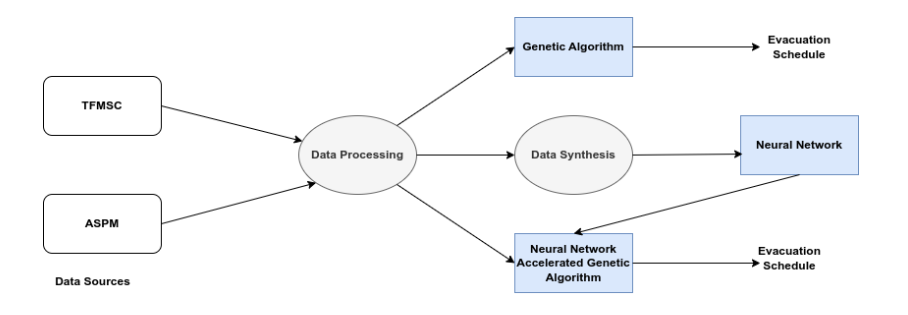
Data Sources
The study uses FAA data sources, including Traffic Flow Management System Counts and Aviation System Performance Metrics. The data is processed hourly so the framework can reason about airport capability over time.
The case study focuses on nine major airports in Florida, a relevant region because hurricanes frequently threaten the state. For each origin airport, the top ten destination airports are considered as candidates for additional evacuation scheduling.
This framing keeps the optimization problem focused. The system does not search the entire national airport network. It searches plausible destination choices based on historical operations and capacity.
Why Use a Genetic Algorithm?
Genetic algorithms are useful for combinatorial optimization problems where the search space is large and discrete.
In this case, a chromosome represents a selection of destination airports. Each candidate solution decides which of the top ten destination airports should be included in the evacuation schedule.
The fitness function rewards airport selections that provide high capability and popularity while penalizing choices that exceed available capacity or introduce too much variability. Over many generations, the genetic algorithm searches for better combinations.
The downside is computation. A genetic algorithm may need a large population and many generations to converge, which can be costly when decisions need to be made quickly before a disaster.
Why Add a Neural Network?
The neural network is not used to replace the optimizer. It is used to accelerate it.
The NN learns patterns from synthetic training data and predicts promising destination-airport selections. These predicted selections are then injected into the genetic algorithm’s population, giving the search process better starting points.
This matters because a GA spends part of its effort discovering the rough shape of good solutions. If the NN can suggest high-quality candidates early, the GA can converge faster.
Two integration strategies are tested:
- Random integration, where NN-predicted candidates are added into the GA population.
- Selective integration, where NN-predicted candidates replace lower-ranked GA candidates.
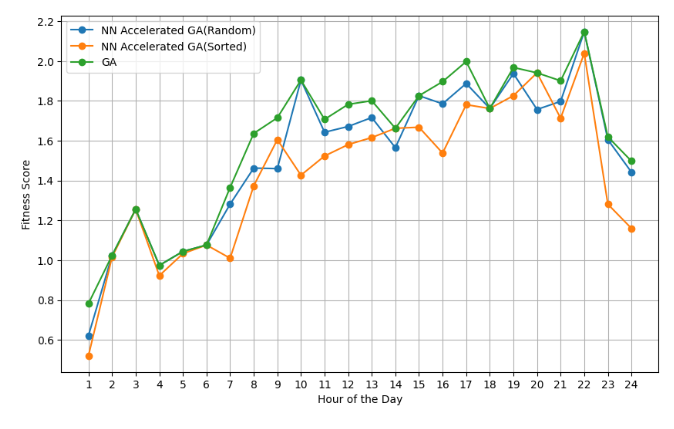
The random integration approach performs better in the reported experiments.
Results
The standalone genetic algorithm performs well when given enough population size and generations. The study finds useful convergence around a population size of 75 and 25 generations. But that configuration requires more computation.
The neural network stabilizes after about 25 training epochs. On its own, it does not outperform the GA, but that is not its role. Its value is in guiding the GA.
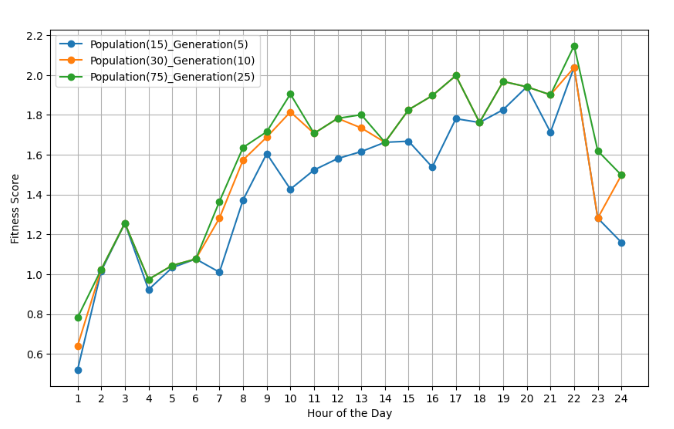
The NN-accelerated GA reaches comparable solutions with a much smaller search process: population size 15 and 5 generations. That is the key result. The hybrid model produces near-identical airport selections with much lower computational load.
Why This Matters
Pre-disaster planning is time-sensitive. A method that produces good evacuation schedules faster can support better operational decisions when the forecast window is shrinking.
The framework is also useful because it does not require building a completely new evacuation aviation system. It looks for capacity in existing non-commercial aviation operations and tries to use that capacity more intelligently.
For air mobility planners, the broader lesson is that machine learning can support optimization without replacing it. The neural network learns where good solutions tend to be, while the genetic algorithm still performs the final search and constraint balancing.
Limitations
The framework depends on historical operations data and synthesized training examples. Real disasters introduce disruptions that may not appear in historical data: airport closures, fuel shortages, staffing constraints, runway damage, changing storm tracks, emergency priorities, and airspace restrictions.
The model also focuses on destination-airport selection, not the full evacuation logistics chain. Passenger access, aircraft availability, crew duty limits, emergency coordination, and ground-side evacuation capacity would need to be integrated for operational deployment.
Final Thoughts
The NN-accelerated GA approach is valuable because it combines learning and search. The neural network speeds up the optimizer by pointing it toward promising regions of the solution space. The genetic algorithm keeps the process flexible enough to handle discrete airport-selection decisions.
For pre-disaster air mobility, that combination can help planners produce evacuation schedules quickly while still accounting for capacity and reliability. It is a practical example of AI supporting high-stakes transportation planning without removing the need for human oversight and operational judgment.
References
- Acharya, K., Velasquez, A., Liu, Y., Liu, D., Sun, L. and Song, H., 2024. Improving Air Mobility for Pre-Disaster Planning with Neural Network Accelerated Genetic Algorithm. arXiv:2408.00790. https://doi.org/10.48550/arXiv.2408.00790
- arXiv record. https://arxiv.org/abs/2408.00790