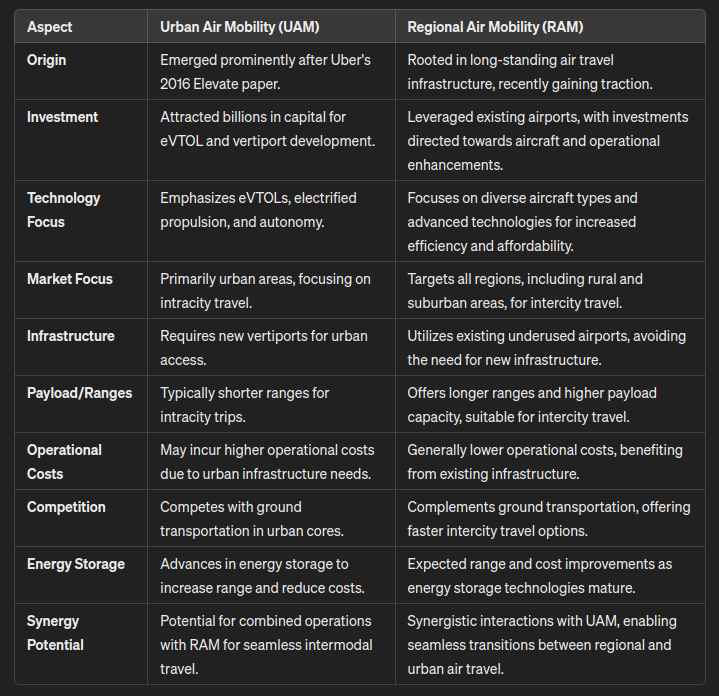
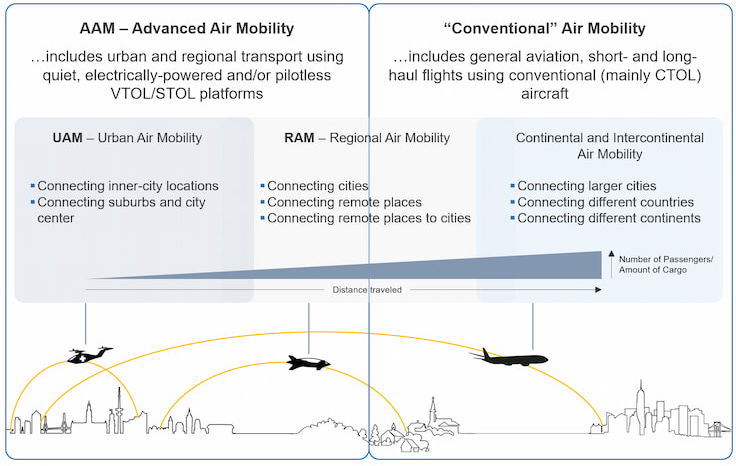
Urban Air Mobility (UAM) and Regional Air Mobility (RAM) are often discussed as if they are competing ideas. In reality, they are two branches of the same larger Advanced Air Mobility movement.
Both aim to make aviation more accessible. Both depend on cleaner propulsion, better automation, digital operations, lower operating costs, and public trust. Both imagine a future where air travel is not limited to large airports, major airlines, and long-distance trips.
The difference is the mission. UAM is about moving people and goods within or around dense metropolitan areas. RAM is about connecting communities across longer regional distances, usually using existing airports. One is built for the city. The other is built for the region.
What Urban Air Mobility Tries to Solve
UAM focuses on short-distance air transportation inside urban and suburban environments. The most common examples are airport shuttles, cross-city air taxis, medical transport, high-priority cargo, and short commuter routes.
The appeal is clear. Large cities have congestion, long airport access times, and limited road capacity. A trip that takes 60 to 90 minutes by car during peak traffic might be much shorter by air if the passenger can reach a nearby vertiport quickly.
That is why UAM is closely associated with eVTOL aircraft. Vertical takeoff and landing allows aircraft to operate from compact sites such as vertiports, adapted rooftops, waterfront facilities, parking structures, or small urban landing areas. In dense cities, that access is the main advantage.
But vertical lift is expensive from an energy perspective. Hovering and vertical takeoff require high power. That affects range, payload, battery sizing, noise, infrastructure, and cost. UAM aircraft gain access to difficult urban locations, but they pay for that access in operational complexity.
What Regional Air Mobility Tries to Solve
RAM targets a different problem: the awkward middle distance. Many trips between 50 and 500 miles are too long to drive comfortably but too inconvenient to fly commercially.
If a traveler must drive an hour to a major airport, arrive early, pass through security, take a connecting flight, and then drive again after landing, the time advantage of flying can disappear. For many regional trips, people choose the car because it is simpler, even when it is slower.
RAM tries to change that by using the large network of existing local and regional airports. The United States has thousands of public-use airports, but only a small share carry most passenger traffic. RAM asks whether cleaner, smaller, more efficient aircraft can make those underused airports useful for everyday regional travel.
Unlike UAM, RAM does not usually require vertical takeoff. Many RAM aircraft can use runways that already exist. That gives them a major efficiency advantage. Fixed-wing aircraft generally fly farther, carry more payload, and use less energy than VTOL aircraft on the same route.
The Shared Technology Base
UAM and RAM are different markets, but they benefit from many of the same technology trends.
Electrified propulsion can reduce emissions, noise, and maintenance complexity. Autonomy and increasingly automated operations can improve safety, reduce workload, and eventually lower labor costs. Digital fleet management can help operators reposition aircraft, forecast demand, and match capacity to real-time travel patterns. Better batteries, hybrid systems, lightweight materials, and distributed propulsion can improve aircraft performance in both markets.
Community acceptance is also shared. Whether an aircraft flies above a city neighborhood or a small town near a regional airport, people will care about noise, safety, privacy, emissions, and local benefit. No AAM system can scale if communities feel that the technology is being imposed on them.
The Main Differences
The clearest difference is geography. UAM serves metropolitan areas. RAM connects cities, towns, rural communities, and regional economic centers.
The second difference is infrastructure. UAM needs vertiports or other compact takeoff and landing sites close to where people want to begin and end their trips. RAM can often use existing airports, runways, hangars, and aviation services, although charging, maintenance, passenger handling, and ground connections may still need upgrades.
The third difference is aircraft design. UAM aircraft usually emphasize vertical lift, low noise, and short urban missions. RAM aircraft usually emphasize range, payload, runway performance, energy efficiency, and operating economics.
The fourth difference is the customer use case. UAM competes with taxis, ride-hailing, airport shuttles, and sometimes premium ground transport. RAM competes with driving, regional buses, trains, and short-haul commercial flights.
Why UAM Aircraft May Not Be Ideal for RAM
It is possible for a UAM-style VTOL aircraft to serve some shorter regional routes. If a passenger values direct access to an urban core, the ability to avoid a runway may be worth the extra cost.
But for many RAM missions, a dedicated fixed-wing or short-takeoff aircraft is likely to be cheaper and more efficient. The reason is physics. Vertical takeoff and landing consumes significant energy that could otherwise be used for range or payload. If both origin and destination already have usable airports, there may be little reason to pay the VTOL penalty.
This is where the two markets may separate. UAM aircraft are optimized for access. RAM aircraft are optimized for distance and efficiency.
Where the Markets Could Overlap
The boundary between UAM and RAM will not be perfectly clean. As batteries improve, UAM aircraft may gain enough range to serve nearby regional markets. A long-range eVTOL could fly from a city center to a nearby town without requiring passengers to visit an airport.
At the same time, RAM operators may use regional airports near cities and then rely on ground transportation or UAM services for the final urban leg. In that model, RAM gets the passenger close to the metropolitan area, and UAM handles the difficult last stretch into the dense urban core.
This could create a layered network:
- RAM connects cities and regions over medium distances.
- UAM distributes passengers within dense urban areas.
- Ground transportation handles short local access where air travel is unnecessary.
That layered system is more realistic than expecting one aircraft type to serve every mission.
Economics Will Decide a Lot
The future split between UAM and RAM will depend heavily on cost. Passengers may like the idea of flying, but they will compare the full trip: price, time, reliability, comfort, access, baggage, parking, transfers, and schedule flexibility.
UAM may attract premium markets first because vertiports, battery charging, airspace management, and high-frequency urban operations are expensive. Airport transfers and business travel may be early use cases because travelers already pay for time savings.
RAM may be more competitive where existing airports reduce infrastructure costs and where driving times are long enough to make air service attractive. A regional route does not need to be glamorous. It needs to save enough time, operate reliably, and cost enough less than the alternatives to build repeat demand.
Infrastructure Is the Real Divider
The biggest practical difference between UAM and RAM may not be the aircraft. It may be the ground network.
UAM needs new or heavily adapted infrastructure inside busy urban areas. That brings land-use challenges, zoning, community concerns, emergency planning, airspace complexity, and high real estate costs.
RAM starts with a different advantage: the airport system already exists. Many regional airports have runways, airspace procedures, maintenance facilities, and local governance. They may still need upgrades for charging, passenger flow, digital operations, and intermodal access, but the basic aviation footprint is already there.
That makes RAM attractive from a deployment perspective. It can build on national investments already made over decades.
How They Can Work Together
The strongest future is not UAM versus RAM. It is UAM plus RAM.
Imagine a passenger traveling from a small city to a major downtown meeting. RAM could carry the passenger from a local airport to a regional airport near the destination city. A UAM aircraft or high-quality ground connection could then handle the final urban segment. The passenger avoids the long drive, avoids the major hub airport, and gets closer to the destination with fewer wasted steps.
The same logic applies to cargo, medical transport, emergency response, and time-sensitive logistics. RAM can move people or goods across the region. UAM can distribute them inside the city.
Final Thoughts
UAM and RAM share the same technological roots, but they are designed for different travel problems. UAM is about short, dense, urban movement where vertical access matters. RAM is about medium-distance regional connectivity where existing airports and efficient aircraft matter.
The two systems should not be judged by the same yardstick. A great UAM aircraft may be a poor RAM aircraft. A great RAM aircraft may be useless for a rooftop vertiport. The mission defines the design.
If both mature, they could form a connected Advanced Air Mobility network: regional aircraft bringing travelers between communities, urban aircraft moving them through dense cities, and ground systems tying the trip together. That is a more practical vision than choosing one model and expecting it to solve every mobility problem.
References
- Antcliff, K., Borer, N., Sartorius, S., Saleh, P., Rose, R., Gariel, M., Oldham, J., Courtin, C., Bradley, M., Roy, S., Lynch, B., Guiang, A., Stith, P., Sun, D., Ying, S., Patterson, M., Schultz, V., Ganzarski, R., Noertker, K., Combs, C. and Ouellette, R., 2021. Regional Air Mobility: Leveraging Our National Investments to Energize the American Travel Experience. NASA Technical Reports Server. https://ntrs.nasa.gov/citations/20210014033
- NASA, Advanced Air Mobility. https://www.nasa.gov/mission/advanced-air-mobility/
- NASA, Urban Air Mobility Airspace Integration Concepts and Considerations. https://ntrs.nasa.gov/citations/20180005218